Today, while reading the Rust documentation for the Iterator trait, I came across an interesting note in the collect() method section.
It explains that collect() is more flexible than it might first appear:
collect()can also create instances of types that are not typical collections. For example, aStringcan be built fromchars, and an iterator ofResult<T, E>items can be collected intoResult<Collection<T>, E>.
This behavior is particularly useful when you want either:
- to short-circuit immediately when the first error occurs, or
- all operations to succeed and collect the results.
For example:
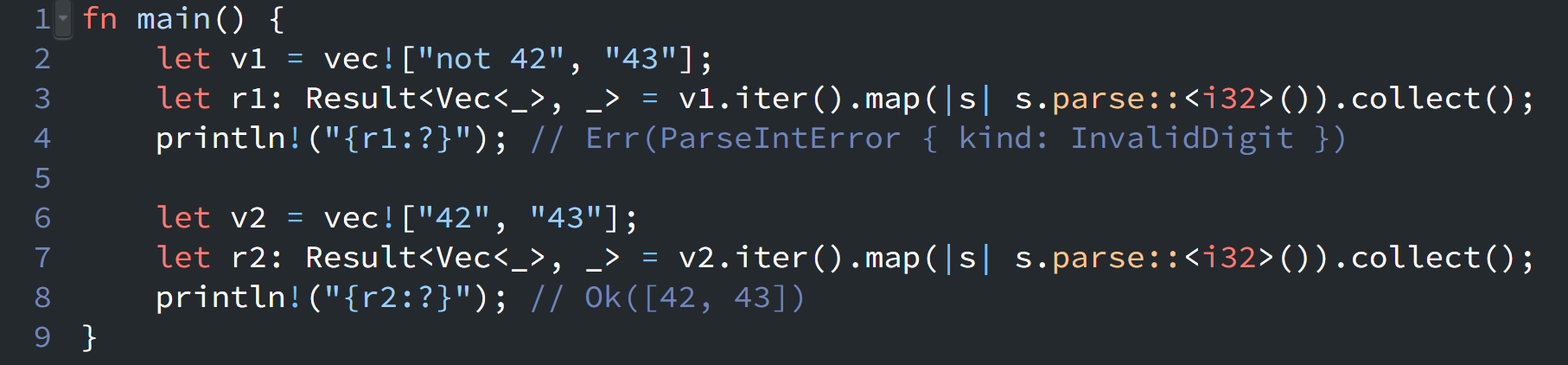
fn main() {
    let v1 = vec!["not 42", "43"];
    let r1: Result<Vec<_>, _> = v1.iter().map(|s| s.parse::<i32>()).collect();
    println!("{r1:?}"); // Err(ParseIntError { kind: InvalidDigit })

    let v2 = vec!["42", "43"];
    let r2: Result<Vec<_>, _> = v2.iter().map(|s| s.parse::<i32>()).collect();
    println!("{r2:?}"); // Ok([42, 43])
}
In r1, the string "not 42" fails to parse as an i32, so the entire computation short-circuits and returns the first error (ParseIntError). The subsequent value "43" is never processed.
In contrast, r2 contains only valid numeric strings, so all elements are successfully parsed and collected into a Vec<i32> wrapped in Ok.
This post was drafted by me, with AI assistance to refine the content.