Today I learned about the FromStr and TryFrom traits. At first glance, they seem very similar, but they represent different kinds of conversions.
According to the standard library documentation, FromStr is used to parse a value from a string, while TryFrom is for fallible type conversions—converting one type into another where the conversion may fail in a controlled way.
Another interesting point is that the convenient str::parse() method is implemented through the FromStr trait.
Here’s a simple example:
use std::convert::TryFrom;
use std::str::FromStr;

#[derive(Debug)]
// A validated port number instead of a raw u16.
struct Port(u16);

#[derive(Debug)]
enum PortError {
    NotNumber,
    InvalidPort,
}

impl TryFrom<u16> for Port {
    type Error = PortError;

    fn try_from(value: u16) -> Result<Self, Self::Error> {
        // Validate domain-specific rules for a valid port.
        // For example, port 0 is reserved and not accepted here.
        if value == 0 {
            return Err(PortError::InvalidPort);
        }

        Ok(Self(value))
    }
}

impl FromStr for Port {
    type Err = PortError;

    fn from_str(s: &str) -> Result<Self, Self::Err> {
        // First parse the string representation into a numeric value.
        let value: u16 = s.parse().map_err(|_| PortError::NotNumber)?;

        // Delegate domain validation and construction to `TryFrom`.
        Self::try_from(value)
    }
}

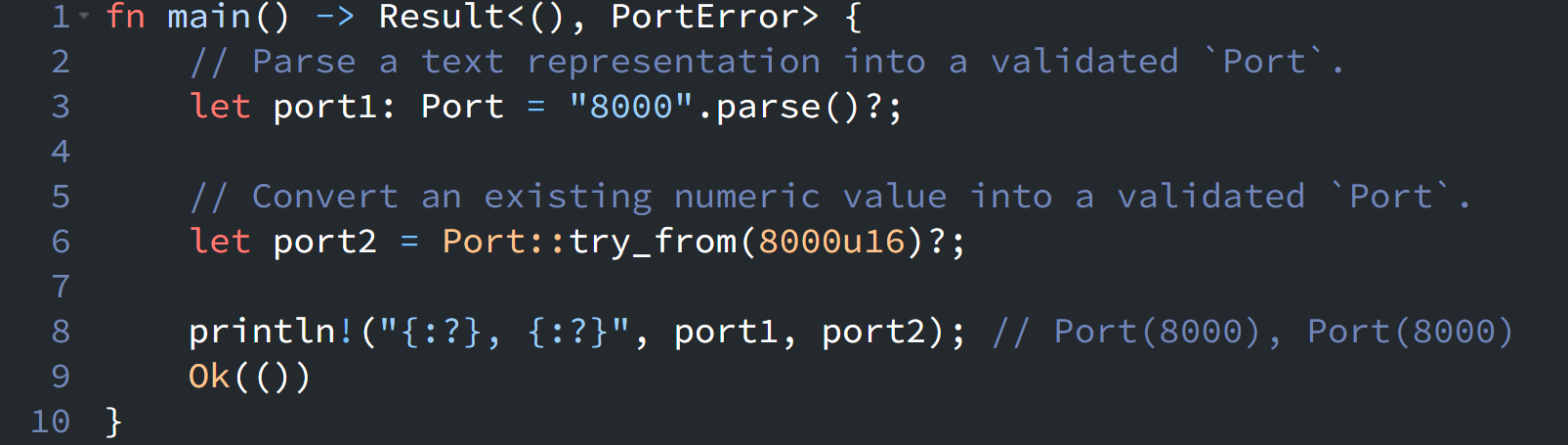
fn main() -> Result<(), PortError> {
    // Parse a text representation into a validated `Port`.
    let port1: Port = "8000".parse()?;

    // Convert an existing numeric value into a validated `Port`.
    let port2 = Port::try_from(8000u16)?;

    println!("{:?}, {:?}", port1, port2); // Port(8000), Port(8000)

    Ok(())
}
In this example, the call to parse() in main() automatically uses the FromStr implementation for Port. Rather than implementing all the conversion logic itself, from_str() acts as a composition layer: it first parses the text representation into an intermediate value (u16), then delegates domain validation and construction to TryFrom<u16>.
This allows users to construct a validated Port from either text input ("8000".parse()) or an existing numeric value (Port::try_from(8000u16)), while keeping the validation logic centralized in one place.
This post was drafted by me, with AI assistance to refine the content.