Today, while reading the documentation for the Iterator trait, I learned more about how iterator adaptors can be combined to create custom iteration patterns.
The standard enumerate() adaptor is a convenient way to add an index to each item in an iterator. However, Rust’s iterator ecosystem provides many other adaptors that can be combined together to build more flexible iteration behaviors.
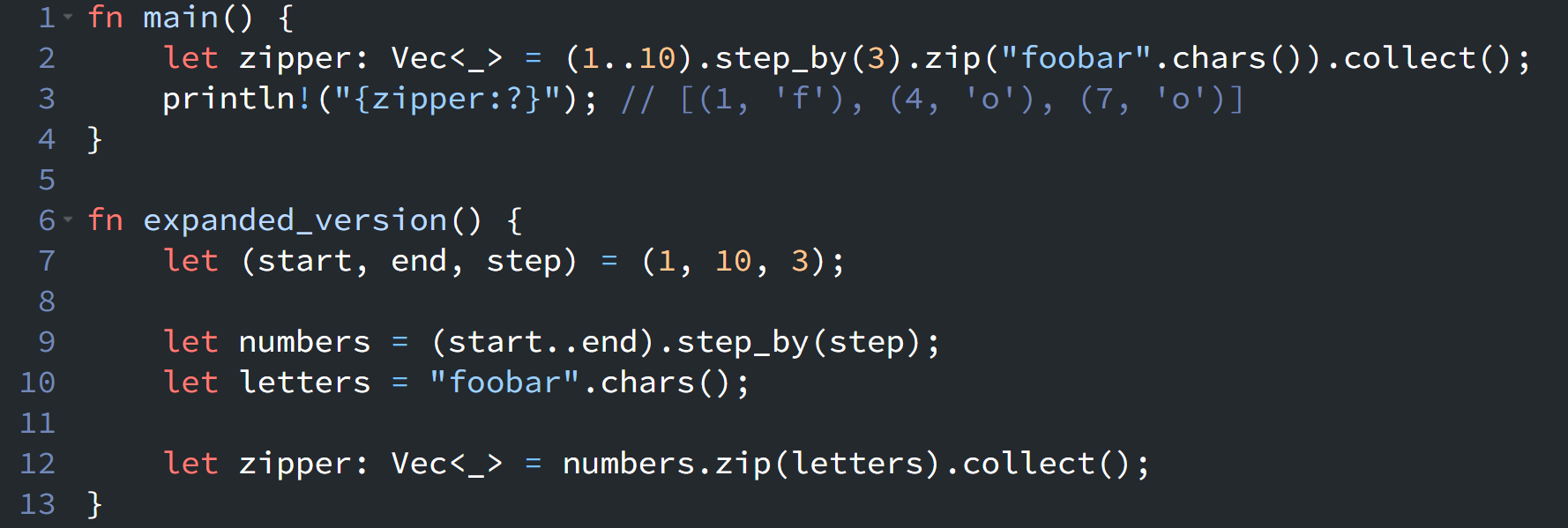
For example, by combining adaptors such as step_by() and zip(), we can create an iteration pattern that generates values with a specific start value, end value, and step size, then combines them with another iterator.
fn main() {
    let zipper: Vec<_> = (1..10).step_by(3).zip("foobar".chars()).collect();
    println!("{zipper:?}"); // [(1, 'f'), (4, 'o'), (7, 'o')]
}
The iterator chain works as follows:
(1..10)creates a range:1, 2, 3, 4, ... 9.step_by(3)keeps every third value:1, 4, 7.zip("foobar".chars())combines the numbers with the characters.collect()consumes the iterator and collects the final result:[(1, 'f'), (4, 'o'), (7, 'o')]
For learning purposes, the same code can be expanded into smaller steps:
fn expanded_version() {
    let (start, end, step) = (1, 10, 3);

    let numbers = (start..end).step_by(step);
    let letters = "foobar".chars();

    let zipper: Vec<_> = numbers.zip(letters).collect();
}This post was drafted by me, with AI assistance to refine the content.